Loading...
Searching...
No Matches
pyhyperiso.core.BusinessLogic.ObservableValue.ObservableValue Class Reference
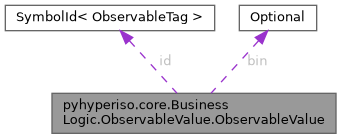
Collaboration diagram for pyhyperiso.core.BusinessLogic.ObservableValue.ObservableValue:
Public Member Functions | |
| None | __post_init__ (self) |
| "ObservableValue" | from_observable (cls, Observables obs, float value, Optional[Tuple[float, float]] bin=None) |
| "ObservableValue" | from_cpp (cls, cpp_obj) |
| to_cpp (self) | |
Public Attributes | |
| id | |
| bin | |
| value | |
Static Public Attributes | |
| ObservableId | id |
| float | value |
| Optional | bin = None |
Detailed Description
Value returned by an observable computation.

Attributes:
    id: Internal observable identifier.
    value: Numerical prediction or experimental value.
    bin: Optional bin range ``(low, high)``. ``None`` means that the
        observable is unbinned or that the C++ value did not carry bin
        information.

Example:
    >>> from pyhyperiso.core.BusinessLogic.ObservableValue import ObservableValue
    >>> from pyhyperiso.core.Common.GeneralEnum import Observables
    >>> ov = ObservableValue.from_observable(Observables.BR_BS_MUMU, 3.6e-9)
    >>> ov.value
    3.6e-09
Definition at line 31 of file ObservableValue.py.
Member Function Documentation
◆ __post_init__()
| None pyhyperiso.core.BusinessLogic.ObservableValue.ObservableValue.__post_init__ | ( | self | ) |
Validate and normalize the immutable dataclass fields.

Raises:
    TypeError: If ``id`` is not an ``ObservableId`` or if ``bin`` is
        neither ``None`` nor a two-entry tuple.
Definition at line 53 of file ObservableValue.py.
◆ from_cpp()
| "ObservableValue" pyhyperiso.core.BusinessLogic.ObservableValue.ObservableValue.from_cpp | ( | cls, | |
| cpp_obj | |||
| ) |
Wrap a bound C++ ``ObservableValue`` object.

Args:
    cpp_obj: Bound C++ object exposing ``id``, ``value`` and optional
        ``bin`` fields.

Returns:
    Equivalent Python ``ObservableValue`` instance.
Definition at line 92 of file ObservableValue.py.
◆ from_observable()
| "ObservableValue" pyhyperiso.core.BusinessLogic.ObservableValue.ObservableValue.from_observable | ( | cls, | |
| Observables | obs, | ||
| float | value, | ||
| Optional[Tuple[float, float]] | bin = None |
||
| ) |
Create an observable value from a public observable enum.

Args:
    obs: Public observable enum value.
    value: Numerical value to store.
    bin: Optional bin range ``(low, high)`` for binned observables.

Returns:
    A normalized ``ObservableValue`` instance.

Raises:
    TypeError: If ``obs`` is not an ``Observables`` enum value.
Definition at line 68 of file ObservableValue.py.
◆ to_cpp()
| pyhyperiso.core.BusinessLogic.ObservableValue.ObservableValue.to_cpp | ( | self | ) |
Convert this value to the bound C++ representation.

Returns:
    A C++ ``ObservableValue`` pybind11 object.
Definition at line 107 of file ObservableValue.py.
Member Data Documentation
◆ bin [1/2]
|
static |
Definition at line 51 of file ObservableValue.py.
◆ bin [2/2]
| pyhyperiso.core.BusinessLogic.ObservableValue.ObservableValue.bin |
Definition at line 62 of file ObservableValue.py.
◆ id [1/2]
|
static |
Definition at line 49 of file ObservableValue.py.
◆ id [2/2]
| pyhyperiso.core.BusinessLogic.ObservableValue.ObservableValue.id |
Definition at line 60 of file ObservableValue.py.
◆ value [1/2]
|
static |
Definition at line 50 of file ObservableValue.py.
◆ value [2/2]
| pyhyperiso.core.BusinessLogic.ObservableValue.ObservableValue.value |
Definition at line 65 of file ObservableValue.py.
The documentation for this class was generated from the following file:
- /home/runner/work/Hyperiso/Hyperiso/Hyperiso/Hyperiso/pyhyperiso/core/BusinessLogic/ObservableValue.py