Flavour observables, Wilson coefficients and statistical inference through one shared C++ backend
hyperiso-ui command-line interface and the Dash graphical interface. Build, install and run a first calculation.
Modules, data flow and optional backends.
JSON defaults, YAML overrides and LHA-family files.
C++, Python, CLI and Dash workflows.
Uncertainties, chi-square fits and confidence contours.
Frozen release references and provenance.
Where to add physics, bindings, tests and documentation.
Classes, structures, files and call graphs.
Scientific scope
HyperIso evolves the SuperIso calculation model into a layered and extensible software architecture. It supports:
- Wilson-coefficient matching and running for the implemented coefficient groups;
- native Standard Model, two-Higgs-doublet and supersymmetric workflows;
- optional leading-order Wilson coefficients generated for generic BSM models through MARTY;
- flavour-observable predictions in the implemented B, D and K decay families;
- Monte-Carlo uncertainty propagation, correlated experimental inputs, maximum-likelihood fits, chi-square fits and two-dimensional confidence contours;
- LHA, SLHA and FLHA input together with reproducible JSON defaults and YAML overrides.
The exact observable and coefficient catalogue is available from the generated class and enum indices. Features outside the supported release scope are listed in the repository's KNOWN_LIMITATIONS.md file.
Data flow
The diagram below summarizes how numerical inputs enter the runtime database, how model-dependent short-distance information is converted into Wilson coefficients, and how observables feed the statistical layer.
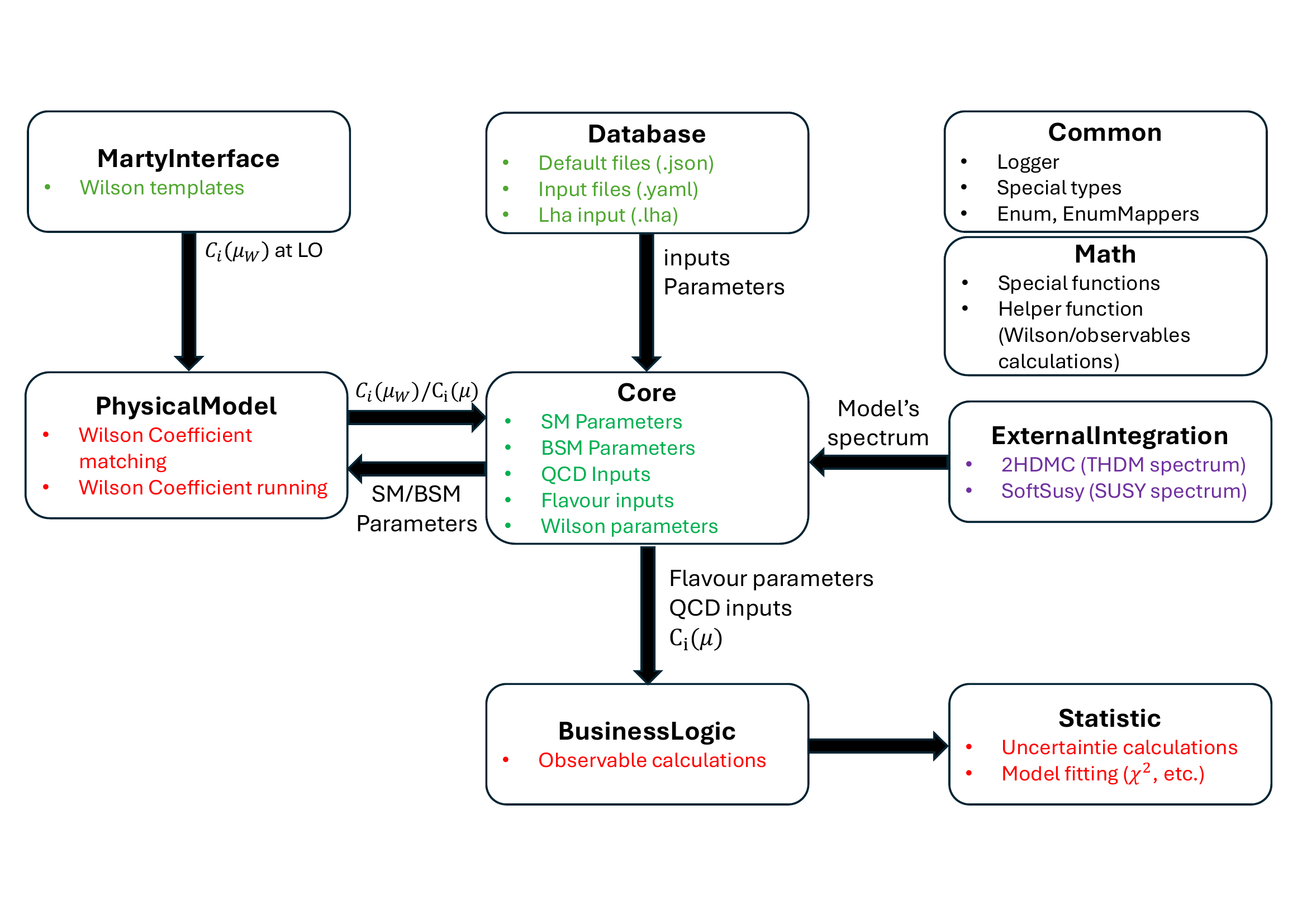
The principal user-facing C++ façades are:
- HyperisoMaster for initialization, input paths and optional runtime integrations;
- WilsonInterface for Wilson-coefficient matching, running and inspection;
- ObservableInterface for observable selection and prediction;
- StatisticInterface for uncertainty propagation, fits, scans and contours.
First Python calculation
First C++ calculation
Installation routes
- Python users:
python -m pip install pyhyperiso==1.0.3once the release is published. - C++ and CLI users: configure and install the CMake project; see Getting started.
- GUI users: install the Python package and the Dash requirements, then start
GHyperiso/HyperisoDashGUI/app.py.
Publication and citation
The source repository, release assets, reproducibility metadata and CITATION.cff are intended to identify the same immutable release. When using HyperIso in scientific work, cite both the associated article and the software release tag.