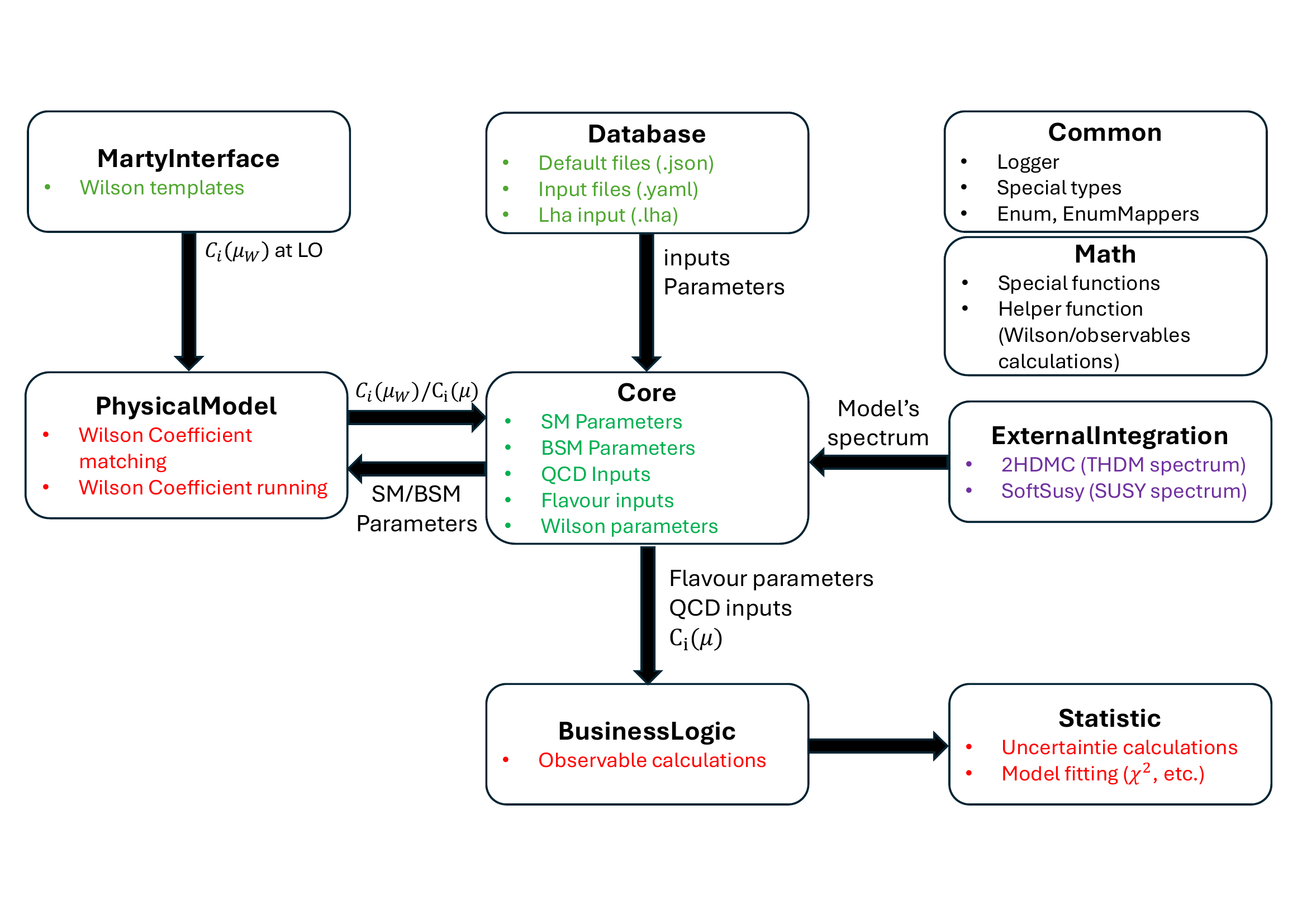
HyperIso uses a modular, ports-and-adapters style architecture. Physics logic, input loading, numerical utilities and user interfaces are separated so that they can be validated independently while sharing one runtime state.
Module map
| Module | Responsibility |
|---|---|
Common | Shared identifiers, enums, mappers, logging and low-level types. |
DataBase | Typed blocks, JSON/YAML/LHA readers, correlations and database export. |
Core | Runtime configuration, parameter memory, initialization and QCD/flavour inputs. |
PhysicalModel | Model-dependent Wilson matching and renormalization-group running. |
BusinessLogic | Decay calculators, observable projections and numerical integrations. |
Statistic | Nuisance distributions, uncertainty propagation, likelihoods, fits and contours. |
Math | Special functions, interpolation, integration and numerical helpers. |
ExternalIntegration | Optional MARTY, 2HDMC and SOFTSUSY adapters. |
UserInterface | The hyperiso-ui command-line application. |
One backend, four frontends
The C++, Python, CLI and Dash layers all initialize the same core through HyperisoMaster. Consequently, the following rules do not depend on the selected frontend:
- default database loading;
- YAML and LHA-family override precedence;
- model and external-backend selection;
- Wilson matching and running;
- observable registration and calculation;
- statistical nuisance and correlation handling.
This shared path is important for scientific comparison: a command reproduced through the CLI should exercise the same core calculations as the equivalent Python or C++ program.
Initialization sequence
A typical initialization performs the following operations:
- create the concrete database and correlation loaders;
- resolve distributed asset paths and optional user path overrides;
- load the default JSON parameter blocks;
- apply user YAML overrides;
- parse the LHA, SLHA or FLHA input;
- initialize or consume the requested model spectrum;
- cache the resulting parameter state for Wilson and observable calculations.
HyperisoMaster also exposes pre-initialization hooks for additional block prototypes, writable caches, custom database paths and external installations. These hooks must be configured before init() whenever they need to affect the first load.
Wilson and observable pipeline
The PhysicalModel layer produces coefficient groups at the matching scale and runs them to the scale requested by an observable. The BusinessLogic layer then combines these coefficients with the shared flavour and QCD inputs to calculate decay amplitudes and user-facing observables.
The origin of the Wilson coefficients is deliberately hidden from the observable layer. A coefficient can come from a native SM/THDM/SUSY implementation or from an optional MARTY-generated implementation; the observable receives the same internal coefficient representation.
Optional external integrations
MARTY
MARTY is used for generic-model Wilson matching at the perturbative order implemented by that workflow. It is disabled by default. A runtime installation can be registered before initialization:
The equivalent Python method is available on HyperisoMaster. HyperIso validates the include directory and libmarty before entering MARTY mode.
Spectrum calculators
2HDMC and SOFTSUSY support spectrum-oriented workflows. Release-level reproducibility examples consume archived spectrum files where possible, so the external generator does not need to be rerun to check the frozen numerical outputs.
Design implications for contributors
- Physics implementations should depend on interfaces rather than user-facing frontends.
- New public C++ types exposed to Python require synchronized pybind11 and high-level wrapper changes.
- Input schema changes require database, reader, example and reproducibility updates in the same pull request.
- A new observable should be tested at the decay-calculator level and through at least one public interface.
See Extending HyperIso for a practical contribution map.